
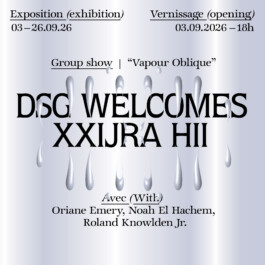

September 4th - 26th
September 3rd Vernissage
Open Wednesday–Saturday, 14h–19h
DS Galerie
15 rue Béranger
75003 Paris, France
Xxijra Hii is pleased to present Vapour Oblique, a three-person exhibition with Oriane Emery, Noah El Hachem and Roland Knowlden Jr., hosted by DS Galerie, Paris, as part of the inaugural edition of DSG WELCOMES.
Bringing together painting and sculpture, the exhibition considers the nebulous as a form of protection, rebellion and transformation. Across the three practices, identity is not presented as a fixed position or a resolved narrative, but as something assembled through fragments: a stain, an eye, a curve, a domestic gesture, a spatial clue, a withheld inheritance. What travels through these works is never fully exposed. It is carried, re-routed, partially translated and sometimes deliberately kept out of reach.
The exhibition aims to understand movement and transmutation as a pressure placed on memory and transmission. How much of a history can be shared before it becomes simplified, consumed or misunderstood? What must remain guarded in order to survive circulation? Here, the vague or uncanny becomes a method of care, but also a refusal: a way of resisting the demand to make oneself, one’s lineage or one’s images entirely legible.
In Noah El Hachem’s paintings, portraiture becomes unstable terrain. Carefully rendered figures appear within undetermined spaces, surrounded by recurring leaves, eyes, sweeping curves and angular structures. Drawing on the organic geometries and ornamental defiance of early 20th c. architecture, El Hachem allows the portrait to move beyond likeness, opening instead onto an intuitive pictorial language where the real and imagined remain in negotiation. Growing up in the Ruhr region, El Hachem was surrounded by pragmatic post-war architecture. This decorative style of architecture was comparatively rare and often appeared in former industrial areas; to the artist encountering them felt like discovering something hidden. In practice, he does not consciously imitate these forms; they emerge intuitively while drawing, much like handwriting itself; forming the basis of his visual language. While painting, decisions are made almost instantaneously. In that sense, handwriting is more important than what is written - the marks themselves carry the meaning, while the subject simply becomes the vehicle through which that language is expressed. This results in work that resists stable recognition, turning image-making into a quiet act of transformation.
Roland Knowlden Jr.’s practice explores absence, uncertainty and disorder in tension with systems of knowledge and control. Working across multiple mediums, he uses collage, assemblage and fragmentation to construct speculative geographies in which boundaries, origins and meanings remain contingent. His works operate less as a ‘map’ than as unsettled methods of orientation, bringing found imagery, material rupture and symbolic structure into unstable relation. Across masks, paintings and sculpture, Knowlden returns to the idea of the entryway: not as a stable passage from one place to another, but as a threshold where opacity, disorientation and transformation become active. Absence is not emptiness, but a site of potential; a negative space through which histories may return as traces, clues, rhythms or fragments. His work proposes wayfinding as a rebellious act: a refusal of fixed routes, fixed origins and fixed systems of interpretation.
Oriane Emery’s work approaches métissage as an intimate and political act of reconstruction. Drawing on Swiss-Algerian heritage, archival research, fiction and embodied experience; her practice examines unstable relationships between personal memory, colonial histories, representation and belonging. Emery treats absence, translation and inherited images as active materials: things to be handled, interrupted, re-stitched and made newly legible on her own terms. In recent works, she draws together domestic objects, protective embroidery, inherited symbols and gestures of care in an attempt to slow the circulation of violent images and recover what has been withheld. Algerian eyelet stitches, associated with protection against the evil eye, partially cover and complicate the image, introducing a slower temporality against the speed and repetition of digital circulation. Elsewhere, a stained handkerchief, white tile and Agadez cross become traces of labour, attachment and uncertain orientation. For those made to feel illegitimate by family, nation or history, identity becomes less a given than a quest: a process of gathering strength from rupture, and of authorising oneself through what was once denied.
Together, the three artists propose the nebulous not as absence, but as a living condition. Their works do not resolve identity, reflection, memory or belonging into fixed form. Instead, they create a sensitive territory in which the intimate meets the political, where protection becomes a means of transmission: a way to let something travel without letting it be consumed.
All enquiries to info@xxijrahii.net
–
About DSG WELCOMES
DSG WELCOMES is DS Galerie’s new international invitation programme, opening the gallery’s Paris space to invited galleries and curatorial perspectives. Its inaugural edition welcomes the London-based gallery Xxijra Hii, extending a collaboration initiated at Art-O-Rama, Marseille, in August 2026 after 2 years of curatorial dialogue.
We look forward to hosting DS Galerie in London in 2027 💜

September 4th - 26th
September 3rd Vernissage
Open Wednesday–Saturday, 14h–19h
DS Galerie
15 rue Béranger
75003 Paris, France
Xxijra Hii is pleased to present Vapour Oblique, a three-person exhibition with Oriane Emery, Noah El Hachem and Roland Knowlden Jr., hosted by DS Galerie, Paris, as part of the inaugural edition of DSG WELCOMES.
Bringing together painting and sculpture, the exhibition considers the nebulous as a form of protection, rebellion and transformation. Across the three practices, identity is not presented as a fixed position or a resolved narrative, but as something assembled through fragments: a stain, an eye, a curve, a domestic gesture, a spatial clue, a withheld inheritance. What travels through these works is never fully exposed. It is carried, re-routed, partially translated and sometimes deliberately kept out of reach.
The exhibition aims to understand movement and transmutation as a pressure placed on memory and transmission. How much of a history can be shared before it becomes simplified, consumed or misunderstood? What must remain guarded in order to survive circulation? Here, the vague or uncanny becomes a method of care, but also a refusal: a way of resisting the demand to make oneself, one’s lineage or one’s images entirely legible.
In Noah El Hachem’s paintings, portraiture becomes unstable terrain. Carefully rendered figures appear within undetermined spaces, surrounded by recurring leaves, eyes, sweeping curves and angular structures. Drawing on the organic geometries and ornamental defiance of early 20th c. architecture, El Hachem allows the portrait to move beyond likeness, opening instead onto an intuitive pictorial language where the real and imagined remain in negotiation. Growing up in the Ruhr region, El Hachem was surrounded by pragmatic post-war architecture. This decorative style of architecture was comparatively rare and often appeared in former industrial areas; to the artist encountering them felt like discovering something hidden. In practice, he does not consciously imitate these forms; they emerge intuitively while drawing, much like handwriting itself; forming the basis of his visual language. While painting, decisions are made almost instantaneously. In that sense, handwriting is more important than what is written - the marks themselves carry the meaning, while the subject simply becomes the vehicle through which that language is expressed. This results in work that resists stable recognition, turning image-making into a quiet act of transformation.
Roland Knowlden Jr.’s practice explores absence, uncertainty and disorder in tension with systems of knowledge and control. Working across multiple mediums, he uses collage, assemblage and fragmentation to construct speculative geographies in which boundaries, origins and meanings remain contingent. His works operate less as a ‘map’ than as unsettled methods of orientation, bringing found imagery, material rupture and symbolic structure into unstable relation. Across masks, paintings and sculpture, Knowlden returns to the idea of the entryway: not as a stable passage from one place to another, but as a threshold where opacity, disorientation and transformation become active. Absence is not emptiness, but a site of potential; a negative space through which histories may return as traces, clues, rhythms or fragments. His work proposes wayfinding as a rebellious act: a refusal of fixed routes, fixed origins and fixed systems of interpretation.
Oriane Emery’s work approaches métissage as an intimate and political act of reconstruction. Drawing on Swiss-Algerian heritage, archival research, fiction and embodied experience; her practice examines unstable relationships between personal memory, colonial histories, representation and belonging. Emery treats absence, translation and inherited images as active materials: things to be handled, interrupted, re-stitched and made newly legible on her own terms. In recent works, she draws together domestic objects, protective embroidery, inherited symbols and gestures of care in an attempt to slow the circulation of violent images and recover what has been withheld. Algerian eyelet stitches, associated with protection against the evil eye, partially cover and complicate the image, introducing a slower temporality against the speed and repetition of digital circulation. Elsewhere, a stained handkerchief, white tile and Agadez cross become traces of labour, attachment and uncertain orientation. For those made to feel illegitimate by family, nation or history, identity becomes less a given than a quest: a process of gathering strength from rupture, and of authorising oneself through what was once denied.
Together, the three artists propose the nebulous not as absence, but as a living condition. Their works do not resolve identity, reflection, memory or belonging into fixed form. Instead, they create a sensitive territory in which the intimate meets the political, where protection becomes a means of transmission: a way to let something travel without letting it be consumed.
All enquiries to info@xxijrahii.net
–
About DSG WELCOMES
DSG WELCOMES is DS Galerie’s new international invitation programme, opening the gallery’s Paris space to invited galleries and curatorial perspectives. Its inaugural edition welcomes the London-based gallery Xxijra Hii, extending a collaboration initiated at Art-O-Rama, Marseille, in August 2026 after 2 years of curatorial dialogue.
We look forward to hosting DS Galerie in London in 2027 💜
Xxijra Hii
Enclave 4
50 Resolution Way,
London SE8 4AL
Xxijra Hii is a member of New Art Dealers Alliance (NADA) and the Gallery Climate Coalition (GCC).
Please do not add us to any mailing lists.